
You need to move something heavy. A sofa. A washing machine. A stack of lumber. You could carry it. You could drag it. Or you could slide a moving wooden dolly underneath and roll it. The tool is simple. A flat deck. Four wheels. A rope or handle to pull. But the difference between a dolly that works and one that fights you is in the details.
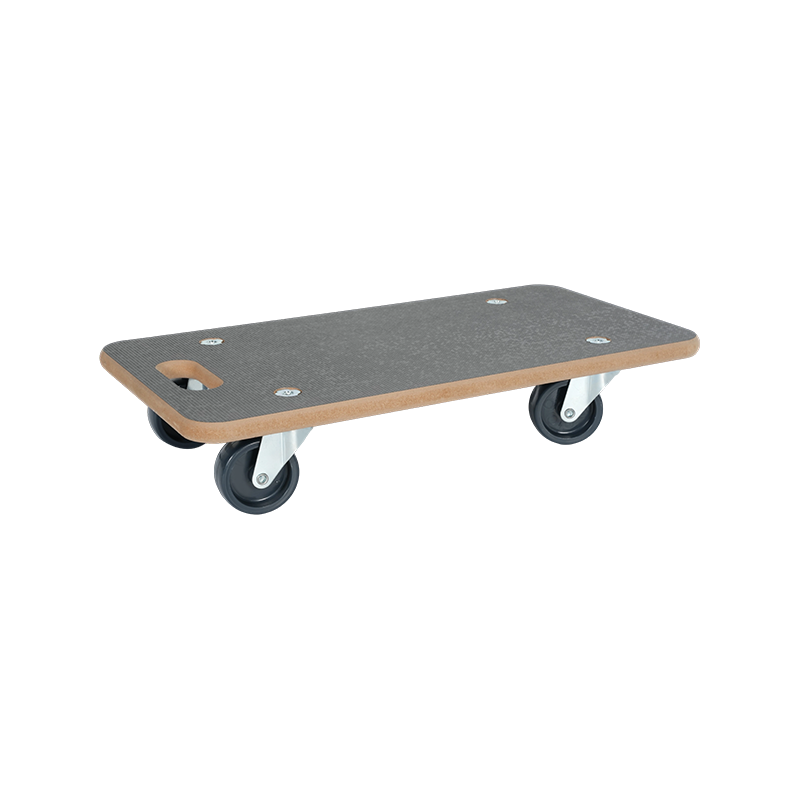
The deck carries the load while the wheels do the work
A moving wooden dolly has a plywood or solid wood deck. The deck sits on a steel frame. The frame holds four casters. You tilt the dolly, slide it under the load, and let it down. The wheels take the weight. You pull. The load moves.
Wooden dollies are not for rough terrain. They work on smooth floors. Concrete. Warehouse epoxy. Hardwood. Take them outside on gravel, and the wheels bind. The dolly stops.
Wood vs. steel decks
Steel dollies are stronger. They handle more weight. A moving wooden dolly is lighter. Easier to slide under a load. Does not scratch floors as easily.
Plywood decks are common. 3/4 inch thickness. Birch or oak plywood resists splitting. Solid pine is cheaper but dents.
Here is how deck materials compare:
Wheels and Casters Determine How Well It Rolls
Caster material affects floor protection
A moving wooden dolly with hard plastic wheels rolls easily on smooth concrete. It scratches wood floors. Nylon wheels are harder. They roll even easier. They scratch more.
Rubber wheels grip better. They do not scratch. But they drag. Harder to pull.
Polyurethane wheels are the middle ground. Soft enough to protect floors. Hard enough to roll smoothly. Good choice for a moving wooden dolly used indoors.
Here is what different wheel materials do:
Caster swivel vs. rigid
Swivel casters turn. Rigid casters roll straight. A moving wooden dolly with four swivel casters is hard to steer. It goes sideways. It fights you.
Two swivel casters at the front and two rigid at the back works good. You steer with the front. The back follows.
Deck size matched to the loads you move
A small moving wooden dolly is 12 by 18 inches. Moves a tool box. Moves a stack of books. Fits in tight spaces.
A medium dolly is 18 by 24 inches. Moves a washing machine. Moves a small cabinet.
A large dolly is 24 by 30 inches or bigger. Moves a sofa. Moves a refrigerator.
Bigger is not always better. A large dolly does not fit through narrow doorways. Match the dolly to your tightest space.
Load rating tells you how much weight it holds
A moving wooden dolly made from 3/4 inch plywood with a steel frame holds 500 to 1,000 pounds. The wheels matter more than the deck. Cheap wheels fail at 200 pounds. Good wheels handle 500 pounds each.
Check the load rating before buying. A dolly rated for 300 pounds will not move your 400 pound safe.
Handle or rope determines how you pull
A pull rope is simple. Cheap. It works. But the rope twists. It gets under the wheels.
A rigid handle is better. The moving wooden dolly has a steel tube that folds down when not in use. Pull from a comfortable height. No bending over.
Here is what to look for in a handle:
The deck splits under heavy loads
Plywood has layers. Cheap plywood has voids. The void is an empty space between layers. Put weight on it. The void collapses. The deck splits. The dolly breaks.
Good plywood has no voids. Marine grade or birch plywood. The layers are solid.
The wheels fall off
Cheap casters have plastic hubs. The hub cracks. The wheel separates from the caster. The dolly tips. The load falls.
Steel hubs cost more. They do not crack.
The caster bolts loosen
Vibration loosens bolts. A moving wooden dolly with lock washers or nylon insert nuts stays tight. One without them wobbles. The caster flops around. The dolly is hard to steer.
A moving wooden dolly is a simple tool. Deck. Wheels. Handle. But small details matter. Birch plywood with no voids. Polyurethane wheels. Two swivel casters, two rigid. Steel hubs, not plastic. Lock washers on the bolts. A folding handle.
Spend a little more on a good dolly. It lasts for years. It saves your back every time you use it. A cheap dolly breaks when you need it most. The load tips. Something gets damaged. That is not saving money. That is costing more. Buy once. Move heavy things without hurting yourself. That is the point.





We sincerely welcome domestic and international customers to visit us and discuss cooperation opportunities!

ykjg@wenlide.com
ykxy@wenlide.com

86-0579-89266926
86-0579-87353489

+86-13735620288
+86-15258987461
+86-13566910892

No. 299, Quanhu Indsutrial Zone, Shizhu Town, Yongkang City, Zhejiang Province, China
Copyright © Yongkang XiangYe Tools Manufacturing Co., Ltd. All Rights Reserved.
Hand Trucks and Transport Trolley Manufacturer


 English
 中文简体
中文简体